

Image Credit: Vessev.
My whole life, I've had a simple rule: if it floats, flies, or has four wheels, I'm interested. And in that time, I've seen electric technology try - and mostly fail - to conquer all three. Electric planes are a nice idea for very short, very brave flights. Electric cars are brilliant, right up until you need to charge one in a hurry. But electric boats? Oh boy... They've always been the problem child.
The issue is physics. Water is thick. It's about 800 times denser than air. Pushing a boat through it takes a colossal amount of energy. This means electric boats have traditionally had two settings: "slow" and "dead." They have the range of a startled house cat and the speed of a tectonic plate. It's a segment ripe for a revolution, or at least a mild, polite uprising.

Image Credit: Vessev.
But speed and range aren't even the biggest killer. The real enemy, the one that keeps marine engineers up at night, is heat. Heat is the arch-nemesis of everything electric. Batteries hate it. Computer chips hate it. And electric motors really hate it. When you're forcing a motor to spin against 800 times the density of air, it gets hotter than a habanero in a sauna. And when your motor is in, say, the Caribbean, where the water itself is basically soup? The whole system just gives up, goes into limp mode, and leaves you to be rescued by the Coast Guard.
That at least was the case until now. Some seriously clever chaps from New Zealand - the land of sheep, hobbits, and terrifyingly fast sailboats - say they've cracked it. The company is called Vessev, and they've sent me a rather excited email announcing their new "VS-Drive." After I wiped away the layer of marketing fluff, the engineering underneath looks clever. Genuinely clever.

Image Credit: Vessev.
The VS-Drive is not just an electric motor. It is a complete "podded propulsion system" with the motor, controller, and propeller, all hiding in a torpedo-shaped unit that lives underwater. VS-Drive uses a direct-drive, brushless motor - no gearbox whining away, no long, vibrating driveshaft eating up half the power. The motor simply spins the prop. That's it. Fewer moving parts means fewer parts to snap, shear, or even spectacularly explode. On a boat, "fewer parts to break" is the most beautiful phrase in any language.
But here is the main event: the cooling. Most marine motors are just "water-cooled," which means they're dunked in the ocean and hope for the best. The VS-Drive, however, has an internal closed-loop cooling system. It's an active system, like the radiator in your car, but built for a submarine. Vessev claims this is so efficient that the motor - while spinning its heart out - operates at less than 122°F (that's 50°C).

Image Credit: Vessev.
To put that in perspective, its maximum tolerance is 212°F (100°C), which is literally the boiling point of water. They are over-engineering the cooling by a factor of two. Vessev's press release, with a straight face, says this makes it cool enough to touch. Now, I am not advising you to hang off the back of a moving boat and caress a 150-horsepower spinning pod. That seems like a bad way to keep your fingers. But the point is, this thing doesn't get stressed. It can run flat-out, all day, in the tropics, and it just won't care.
So, it's cool. But does it have any... power? Well, yes. It provides 90 horsepower continuously, which is its happy cruising state. But if you need to get a move on - perhaps you've seen a waterspout, or the bar is closing - it can peak at 150 horsepower. And because it's electric, it delivers all of its 295 pound-feet of torque instantly. That's proper, boat-shifting grunt.

Image Credit: Vessev.
This magic motor is, of course, attached to a magic boat. It's called the VS-9, and it's not some billionaire's toy - it's a 10-passenger commercial vessel. A water taxi. It's a nearly 30-foot (29'5" to be precise) catamaran built entirely of carbon fiber to keep it light. And it doesn't just sail. It flies.
Ah, yes. Hydrofoiling. The dark art of making a boat pretend it's an airplane. As the VS-9 picks up speed, it rises up on two carbon-fiber stilts, or "foils," lifting the entire hull clear out of the water. This is the secret. By lifting the hull, it escapes the drag of the water. The only things left getting wet are the super-slippery foils and the VS-Drive pod itself. It's the only way to get sensible range from a battery pack on the water.

Image Credit: Vessev.
And the performance numbers are, for an electric boat, deeply impressive. It cruises at a brisk 25 knots (about 29 mph) and has a top speed of 30 knots (just under 35 mph). It's not a speedboat, but for a 10-person shuttle, that's flying. It can even handle waves up to 2 feet 6 inches, though I suspect that would be somewhat less of a flying-carpet ride.
And now, the question I ask of every electric boat: how far does it go before it becomes a very expensive, very modern-art-looking buoy? Vessev claims 50 nautical miles (57.5 miles) with a light load, or 40 nautical miles (46 miles) stuffed with its full complement of 10 passengers. That is actually useful. That's a full day of work for a water taxi, plus it can be DC fast-charged, slurping up 0.8 nautical miles of range every minute.
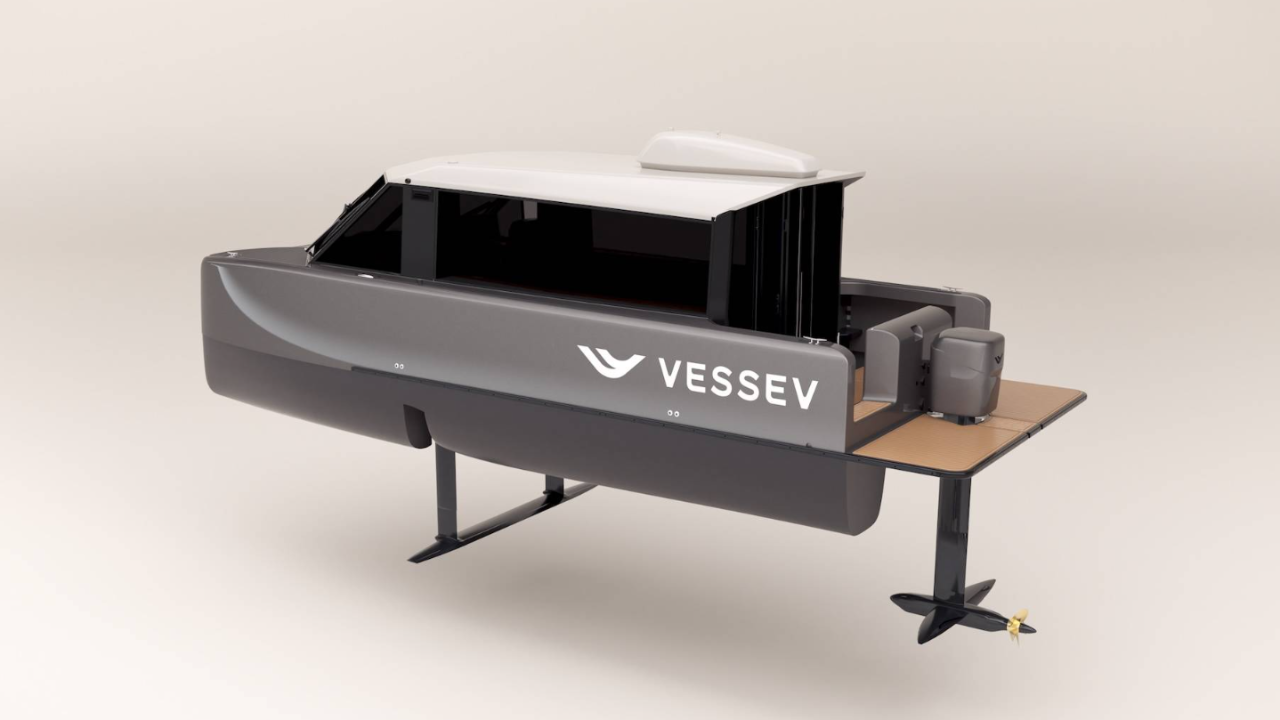
Image Credit: Vessev.
Thankfully, Vessev has also thought about the "oh, bother" moments. The foils are fully retractable, meaning you can pootle into a shallow marina (it only needs 1 foot 8 inches of water with the foils up) without ripping off your hideously expensive carbon-fiber legs. With the foils down, it needs 4 feet 11 inches. The drive itself is also "vectorable," which is marketing-speak for "it turns," making the whole thing easier to park.
And then there's the noise. Or, rather, the complete lack of it. The company says that at low speeds, the VS-9 is "literally" inaudible. At high speeds, you can stand right next to the drive unit and have a "normal-volume conversation." Anyone who has ever owned a traditional outboard motor, which sounds like a bag of wrenches in a tumble dryer, will understand what a monumental improvement this is. You can finally talk to your passengers without screaming.

Image Credit: Vessev.
Naturally, Vessev is very proud of its team, which it says includes experts from Apple, Google, and Tesla. This is, of course, either a sign of supreme technological genius or a terrifying guarantee that the GPS will try to route you through a Starbucks and the whole boat will need a software update in the middle of a harbor.
Jokes aside, this VS-Drive is the real story. Vessev is already planning to scale it up for larger 39-foot and 59-foot vessels. This modular, silent, robust, and cool-running propulsion system might just be the breakthrough electric boating has been waiting for.
Enjoyed the article? Give us a 'LIKE' and FOLLOW us on MSN! We're tracking the electric future... even if it's still buffering.
