Image Credit: Longbow Motors.
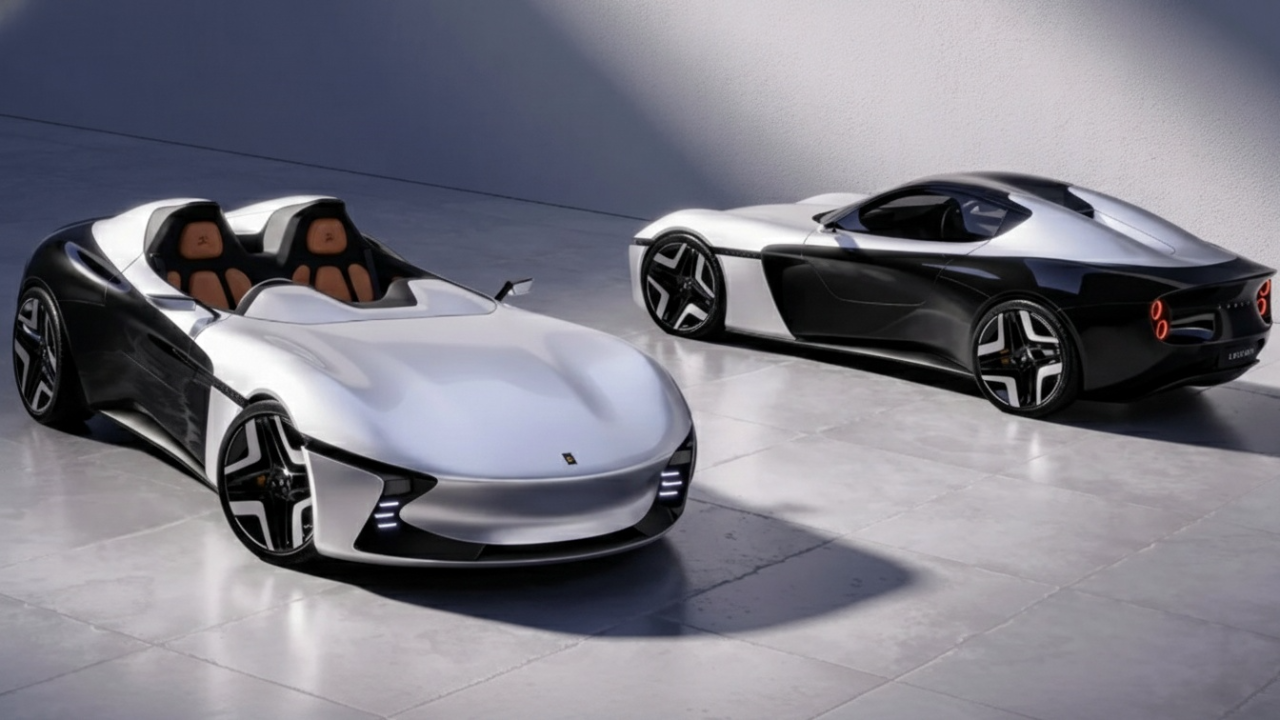
My inbox is bursting with electric car startups. Every week, a new company emerges, usually from a shed in California or a mysterious factory in China, promising to reinvent the wheel. This one, however, is British. It's called Longbow Motors, and they've just unveiled two cars: an open-top thing called the Speedster and a coupe they're calling... the Roadster. Yup, the coupe is the Roadster. We'll get to that magnificent piece of sarcasm in a minute.
Normally, this is where I'd make a cup of tea and move on. But two things stopped me. First, the people behind it aren't just dreamers; they're refugees from companies like Tesla, Lucid, and McLaren. So, they presumably know which end of a lithium-ion cell is the spicy one. Second, they claim they went from idea to creation in six months. This isn't just fast; it's... suspicious. They call it "UK Time," which is hilarious, because usually, "UK Time" means it's been delayed due to a bank holiday or "leaves on the line."

Image Credit: Longbow Motors.
But then I saw the number. The one that actually matters - the weight. We're in an era where electric cars are so heavy they're starting to generate their own gravitational pull. A "performance" EV sedan often weighs more than a medium-sized delivery van. It's a real problem. This Longbow Speedster, the open-top one, supposedly weighs 1,973 pounds. That's 895 kilograms. The Roadster (the one with the roof) is just a bit heavier, at 2,193 pounds.
A sub-2,000-pound electric car. That's the holy grail. It's lighter than a new Mazda Miata. It's a weight figure we haven't seen on a serious sports car since I had hair. This is the entire point. This, they claim, is the "rebirth of the British sports car." A car focused on agility and driver engagement, not just 0-60 times that can rearrange your internal organs. How refreshing.

Image Credit: Longbow Motors.
So, how have they done it? Magic? Have they made the batteries out of helium? Not quite. Instead of a carbon-fiber monocoque that costs more than a modern house, they've used a bespoke aluminum chassis. You know, like a normal sports car. This is wrapped in lightweight composite body panels. It's just clever engineering. It's the "simplify, then add lightness" philosophy that British car makers were famous for before they all got distracted trying to make 6,000-pound luxury SUVs.
Naturally, a light car doesn't need a nuclear reactor to power it. The Longbow gets a single electric motor. On the rear axle, thank goodness. It produces a perfectly sensible 322 horsepower (240 kW). Only 322? Today, a normal electric family crossover has 600… And it weighs 5,500 pounds. 322 horsepower in a 1,973-pound car is a spectacular power-to-weight ratio. It means the car will actually feel alive.

Image Credit: Longbow Motors.
The result is a 0-to-62-mph sprint in 3.5 seconds for the Speedster and 3.6 for the Roadster. More importantly, it's the kind of performance you can actually use on a real road. It's about feeling the car pivot and respond, not just being fired at the horizon like a silent cannonball. They've even used hydraulic-assisted steering for actual "feel."
About that name. Why call the coupe a "Roadster"? It's a magnificent, passive-aggressive dig at their old boss. The founders, being ex-Tesla, are taking a potshot at the other Tesla Roadster. The one that was announced in 2017 and still hasn't arrived. Longbow is basically saying, "We're going to build and deliver our Roadster, which is actually a coupe, before you even finish your actual Roadster."

Image Credit: Longbow Motors.
Of course, it can't all be perfect. This is a British startup, after all. We must have some confusion. And we find it in the battery. The original source material, and I am not making this up, claimed the car uses "2170-format nickel-cadmium cells." The same stuff you could find inside an old cordless drill from 1992. The kind of battery that, if you didn't drain it all the way, would forget how to charge. I'm honestly surprised it doesn't come with a hand crank.
Mercifully, this was "refuted" in a forum chat and is almost certainly a catastrophic typo. They mean 2170-format lithium-ion cells, probably NMC (Nickel-Manganese-Cobalt). But the fact that "Nickel-Cadmium" made it anywhere near an official press release is just a chef's kiss. It fills me with so much confidence.

Image Credit: Longbow Motors.
Because the car is so light, it doesn't need a battery pack the size of a snooker table. The pack is estimated to be a modest 45-60 kWh. This gives it a claimed (and always optimistic) WLTP range of 275-280 miles. The US estimate is closer to 233 miles on the stricter EPA cycle. And you know what? That's fine. It's a weekend toy, not a cross-country hauler. You don't buy a speedboat to cross the Atlantic.
Finally, the price. This is where the dream hits the bank account. The open-top Speedster (limited to 150 units) will start at £84,995, which is about $111,540. Ouch. The much more sensible (and, I think, better-looking) Roadster coupe is a more palatable £64,995, or about $85,275. That's still a huge pile of cash that puts the Longbow in Porsche Cayman territory.

Image Credit: Longbow Motors.
Longbow Motors is building a stunning, genuinely lightweight electric sports car. It's been designed by people who know what they're doing, even if their marketing department seems to be sourcing battery info from a 1980s electronics catalog. I am, as ever, gently skeptical that they can hit their 2026 production date. But I am also desperately enthusiastic. This is the kind of EV I've been waiting for. One that remembers what it feels like to be a car. Please, Longbow, don't mess this up.
Enjoyed the article? Give us a 'LIKE' and FOLLOW us on MSN! We're tracking the electric future... even if it's still buffering.
