
Image Credit: AutoFlight.
If you are anything like me, you spend a significant portion of your life cursing traffic. Be it the dreadful slow crawl on the interstate in a German sedan, or the inevitable snarl in the harbor when some yacht owner tries to dock his monstrosity without having hired a crew that understands physics.
For decades, the solution was supposedly the helicopter. They'd lift you over the misery, depositing you on a skyscraper roof or a repurposed wharf. It was the future! Until everyone realized that rooftop landing pads are few and far between, and you've simply traded a ground traffic jam for a very expensive, very loud air traffic jam.

Image Credit: AutoFlight.
The helicopter dream, with its noisy, fossil-fuel-guzzling heart, flared out faster than a cheap Chinese firework. But now, oh, now we have a new hope: the Electric Vertical Take-Off and Landing vehicle, or eVTOL. We call them air taxis, because "electric, multi-rotor, lift-plus-cruise aircraft" doesn't quite fit on a bumper sticker.
These things promise silent, swift, and clean travel, leaping us over the gridlock like a startled deer over a low fence. They are battery-powered, which naturally excites the part of my brain that tracks charging times, and they are inherently complex, which excites the part of my brain that enjoys the sweet, sweet sound of skepticism.

Image Credit: AutoFlight.
The technology is nearly there. We've got machines that can lift over 4,409 pounds off the ground - that's roughly two grand pianos or one American family on a week-long vacation - and cruise for up to 155 miles on a single charge. Take the Prosperity I from AutoFlight, for example. This is the big kahuna that's supposed to ferry the important people (four of them plus a pilot) around at a brisk clip of 124 miles per hour. That's faster than your average bear and certainly faster than your typical airport shuttle bus.
The problem, however, is the same as it was back in the 1950s: where exactly are you supposed to land these futuristic silent wonders? Are we back to fighting billionaires for space on the roof of the tallest building in town? The very idea gives me a migraine. You need a big slab of safe, easily accessible concrete, and ideally, you need to be able to move it when the city decides that a permanent airport-in-the-sky is a bad place for a new artisanal dog-biscuit bakery.

Image Credit: AutoFlight.
Enter AutoFlight, the clever chaps who clearly ran out of sensible names for their infrastructure solutions. They call their floating airport the Integrated Sea-Air Low-Altitude Economy Solution. Honestly, if you can say that five times fast without having a minor stroke, you deserve to be flown somewhere expensive.
In plain English, they've built an airport on a boat. A barge, to be precise. It's a self-propelled, solar-powered vertiport designed to float wherever the waterfront is suitably sized. The genius here, and I do mean genius in the sense of "why didn't anyone think of just moving the runway?" is the mobility. If the traffic is awful in downtown Miami, you just motor your landing zone a few miles north. Problem solved. This essentially is a giant, floating, zero-emissions welcome mat.

Image Credit: AutoFlight.
This magnificent nautical airport features a huge landing pad - which, naturally, is covered in solar panels to keep those 160 kWh battery packs in the air taxis topped off. Down below, there's a cabin that moonlights as both a technical room (where the wizards keep the lights on) and a departure lounge. I'd imagine the lounge looks less like Heathrow and more like a nicely appointed shipping container, but still, it's progress.
The scale of the operation is quite ambitious. While the passenger-carrying Prosperity I is relatively large - with a wingspan of almost 48 feet and a length of just over 38 feet - the floating vertiport can also handle the company's dedicated cargo rotorcraft, the White Shark and the CarryAll. The passenger version, which carries a typical payload of 772 pounds, achieves its majestic vertical flight using a positively ludicrous 10 lift propellers, backed up by three push propellers for horizontal movement. Thirteen spinning blades! That's more than enough to chop up a very large field of grass, or perhaps cause a nervous twitch in anyone who recalls the reliability of early aviation.

Image Credit: AutoFlight.
The whole floating vertiport idea really shines when you consider its versatility. Sure, urban commuting is the headline, but AutoFlight reckons this barge can be used for everything from offshore maintenance jobs to search and rescue operations, and even air tourism. Want to fly over that gorgeous mountain range? We'll motor the airport right to the nearest lake and set up shop. The demonstration run was even held recently, on November 22, 2025, over Dianshan Lake in Shanghai, proving that this isn't just a sketch on a napkin after too many lagers.
The most optimistic idea, however, is the ability to cluster these portable landing platforms. Got a sudden surge in cargo coming into a port? Simply sail in a few extra floating vertiports and stack them up. It's modular infrastructure! It's like creating an instant, sea-based LEGO airport terminal, ready to service every Prosperity I, White Shark, and CarryAll that suddenly descends upon your reasonably sized waterfront. The only limit is how many you can afford and how quickly you can tow them into position.
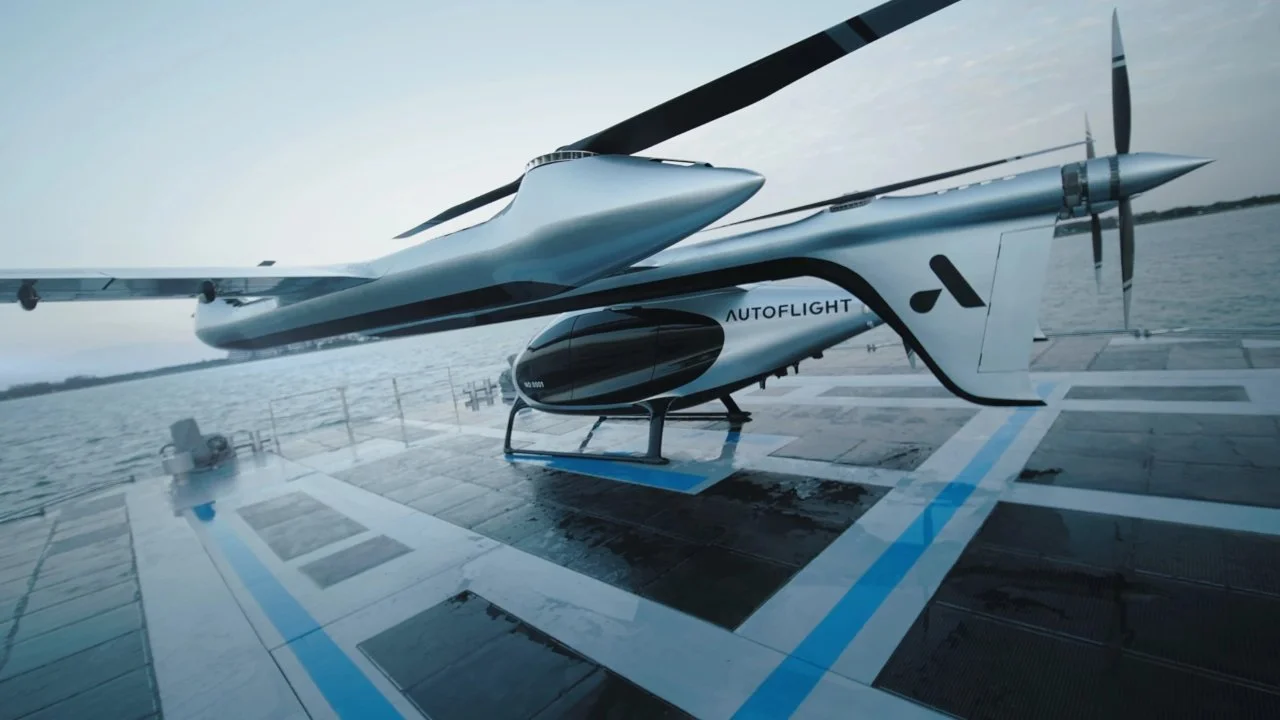
Image Credit: AutoFlight.
The one and only Elliott Richards from Everything Electric was at the picturesque Dianshan Lake for the presentation and recorded his experience. To say he was impressed, is a bit of an understatement - see for yourself:
It is a truly exciting idea. I'm gently skeptical about the name, the cost projections, and the complexity of coordinating dozens of 4,409-pound electric aircraft attempting to land on a bobbing solar array. But this mobile hub is the first genuinely clever solution to the great eVTOL bottleneck. We have the electric sky-taxis; now we have a place for them to plug in and drop off their precious cargo. Of course, once you've landed on your floating pad in the middle of a lake, you still need a smaller boat to get to shore. But hey, one step at a time, right?
Enjoyed the article? Give us a 'LIKE' and FOLLOW us on MSN! We're tracking the electric future... even if it's still buffering.
