
Image Credit: LEO Flight.
Cars, boats, planes, motorbikes; if it moves, I write about it, usually while making some kind of inappropriate noise. And now, we have those electric things. Silent, swift, and, all too often, a bit sensible. Thankfully, from time to time, a project comes along that is so beautifully mad that it drags my cynical old soul right back into the hangar.
The latest object of my cautious affection? The LEO Solo JetBike. It's an electric Vertical Take-Off and Landing (eVTOL) machine, a single-seat personal flying motorcycle, and it's promising to let you bypass traffic without the inconvenience of a pilot's license. A Part 103 friendly flying machine, which is aviation-speak for "it's tiny, it's for sport, and if you crash it, you only have yourself to blame." The company behind it is already taking refundable deposits of $999 for a machine that, if it ever sees the light of day, has a projected base price of $99,900. That's one hundred thousand dollars for the ultimate high-altitude selfie.

Image Credit: LEO Flight.
The company I mentioned above is called LEO Flight, and is the product of a delightfully chaotic partnership. On one side, we have Pete Bitar, a man whose personal YouTube channel appears to be a fever-dream scrapbook of electric-jet propulsion experiments. Pete is clearly the patron saint of the half-finished, the inventor who just cannot stop tinkering. His previous efforts, like the VertiCycle (which looked suspiciously like a garden chair strapped to a garbage can, in fairness), all pointed to a burning obsession with thrust. We love him for his perseverance, even if his test flight videos tend to end right before things get dynamically unstable in a deeply interesting way.
Then there's the other half of the brain trust: Carlos Salaff. He's a former Mazda designer, a chap who actually created things that look brilliant and roll elegantly on four wheels - Mazda Nagare and Furai concept cars, if you're keeping score. Carlos is the bloke who steps in and says, "Pete, my boy, this is a revolutionary personal transport device, not a self-propelled camping accessory." He's here to make the jet-propelled chaos look good. And their earlier, all-CGI concept, the LEO Coupe flying car (with a 250 mph cruise speed and a $459,900 price tag), certainly looks the business, even if it only exists inside a computer screen for now.

Image Credit: LEO Flight.
The Solo, however, is the machine that's supposedly heading to production by late 2025. A timetable which, given that it's already a very late 2025, seems just a tad… ambitious.
The bits that make my aging eyebrows twitch? The propulsion. The Solo uses 48 electric ducted fans - 12 tiny micro-jets tucked neatly into each of the four corners. This gives it a glorious, sleek look and keeps your fingers safely away from rapidly spinning blades, which is a big tick in the 'Pro' column. However, it also introduces a concept called disc loading, which is a rather dry term for a very exciting problem.

Image Credit: LEO Flight.
See, a conventional helicopter has massive, slow-spinning blades, giving it a low disc loading and a very efficient way to push the ground away. The Solo's tiny fans, by contrast, have an astronomically high disc loading. They have to spin so furiously to lift the whole shebang that they become remarkably inefficient. Think of it this way: to keep your butt in the air, those 48 fans are going to be making a sound like a highly stressed Dyson vacuum cleaner running on maximum, and they'll be gobbling battery juice like there's no tomorrow.
And what juice is that? LEO Flight claims the Solo will use a solid-state battery. If you've been paying attention to the EV world, you'll know this is the electric holy grail - lighter, safer, faster-charging, and far more energy-dense than current lithium-ion cells. The problem is that, for the automotive world, these things are still a couple of years away from serious mass production. Betting your entire late-2025 launch on a battery technology that doesn't yet exist commercially is either an act of incredible genius or pure madness. I'm leaning towards a generous helping of the latter, but with a happy smile on my face.
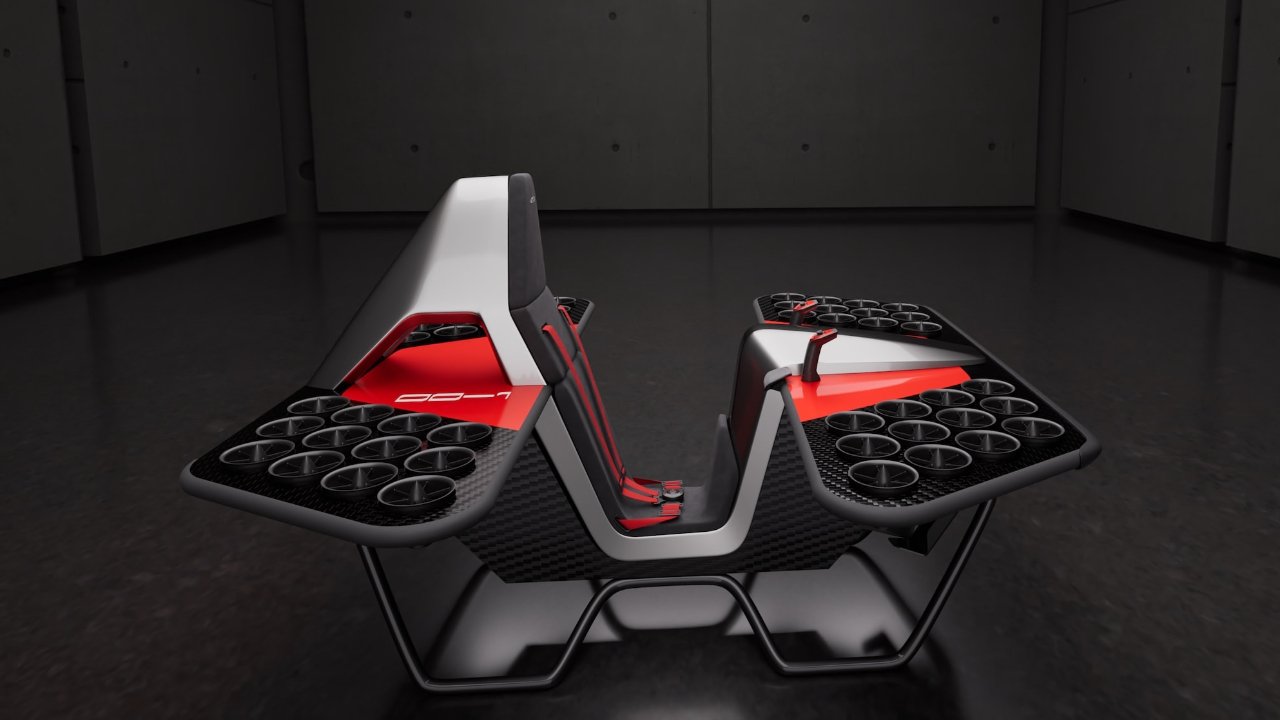
Image Credit: LEO Flight.
What are the numbers, the cold, hard facts that we journalists are supposed to care about? The LEO Solo is designed to be compact, with a footprint of about 6.5 feet by 6.5 feet - roughly the size of an absolute unit of a king-size mattress, meaning it should fit in your standard American garage (provided you've already evicted the lawnmower and the twenty-year-old snow blower).
The maximum party time is a flight endurance of just 10 to 15 minutes. It has an electronically limited top speed of 60 miles per hour and, rather sensibly for a machine with such a short flight time, an electronically limited maximum altitude of 15 feet off the deck. Acceleration times are still a mystery, but given the flight time, it's less about a blistering zero-to-sixty and more about not splattering yourself on the driveway.

Image Credit: LEO Flight.
The fact that you can reserve one for a refundable $999 is a tempting proposition for the tech-obsessed among us. It's early days, though. While there are videos of a brave test pilot making encouraging, albeit boxy, little untethered hops in the prototype platform, it still looks nothing like Mr. Salaff's sleek CGI renders.
Still, the prospect of an electric, personal flying machine that you can charge at home and fly without a license? It's magnificent. And it's almost certainly going to be late. But if Pete Bitar has proven anything over the years, it's that he has the perseverance of a badger trying to dig through concrete. So, I've got my deposit money ready. I just need to decide what color I want my hundred-thousand-dollar flying dream-machine to be - assuming, of course, that I can convince my wife that our kids don't really need the college fund…
Enjoyed the article? Give us a 'LIKE' and FOLLOW us on MSN! We're tracking the electric future... even if it's still buffering.
