
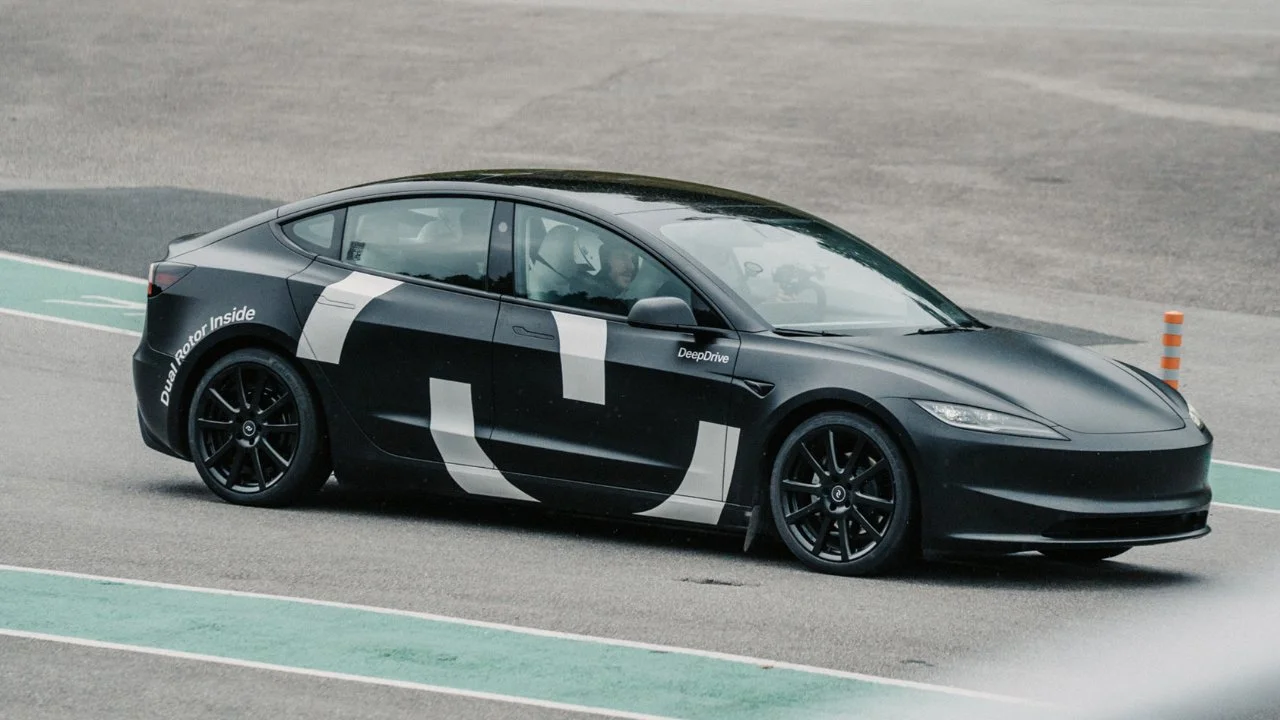
Image Credit: DeepDrive.
Another week, another electric vehicle start-up promising a "revolution." Honestly, I get so many of these pitches that my email has developed a drinking problem. They all promise to change the world with some new battery-powered skateboard that costs more than a beachfront condo and looks like a designer doorstop. Most of them are complete rubbish.
But on very rare occasions, a file lands on my desk that puts my skepticism into a deep sleep. This one comes from Munich, Germany. Of course it does. And it's from a company called DeepDrive.

Image Credit: DeepDrive.
DeepDrive isn't your usual collection of Silicon Valley "visionaries" in expensive sneakers. It was started in 2021 by a handful of young, ambitious German engineers. This group, led by a chap named Dr. Alex Rosen, apparently got "obsessed" with electric motors while on their university's Formula Student team. (And no, he is not the Alex Rosen you'll find on YouTube. This one builds motors, the other... well, you can Google the other one. It's a whole thing.)
After graduating, these bright young minds did what all bright German engineers do: they went to work for massive, beige technology corporations. And, like all bright young minds in massive, beige corporations, they got "frustrated." They saw that the electric drive systems of the day were "awful," losing something like 40% of their energy to heat and friction.

Image Credit: DeepDrive.
Today, that's better - more like 25% - but that, as Dr. Rosen says, still leaves "a huge margin to work with." So, they did the only sensible thing: they quit, formed their own company, and started building the one thing everyone in this business has been dreaming of - and failing at - for decades. The in-wheel motor.
Yes, I know. The "in-wheel motor" is as elusive as the flying car. It's been "just five years away" for the last fifty years. The idea itself is brilliant. Why have one big, heavy motor, gearboxes, differentials, and all those greasy driveshafts cluttering up the car? Why not just put a small, powerful motor inside each wheel?

Image Credit: DeepDrive.
Think about it! You'd get perfect all-wheel drive. You'd get "torque vectoring" so precise it could make a rhinoceros handle like a sports car. And the space. With no engine, no transmission tunnel, and no diffs, you could design a car that's basically a luxurious living room on a set of wheels. The proportions, as the company says, would be "never seen before."
So why don't we have them? One simple, horrible phrase: unsprung mass. It's the weight of everything that isn't held up by the suspension (the wheel, the tire, the brake). Adding a heavy motor out there is like trying to go for a jog while wearing cement boots. It's terrible for ride comfort, making the car crash over every bump. It's terrible for handling, which becomes agricultural.

Image Credit: DeepDrive.
This is where DeepDrive claims to have pulled a rabbit out of its Lederhosen. They say their research has cracked the problem. Their magic bullet is a patented "Dual-Rotor, Radial-Flux" design. In a normal motor, a stationary part (the stator) spins a moving part (the rotor). In DeepDrive's motor, the stator sits in the middle and spins both an inner and an outer rotor simultaneously. It's a fiendishly clever way to get more power and torque out of a very small package.
And the numbers tell quite a story. Their main unit is called the IW 2000, and is designed to fit a 19-inch wheel, but can be adapted down to 16 inches. It weighs just 75 pounds, which might not sound light for a corner, but that 75 pounds includes the motor and the power inverter. And then there's the torque. This little unit produces 1,475 pound-feet (2,000 Nm). That's... biblical. That's more torque per wheel than most supercars have in total.

Image Credit: DeepDrive.
The best part is how they're solving that unsprung mass problem. They've teamed up with Continental - you know, the people who make tires and brakes - to build the brake inside the motor module. So, you're not just adding 75 pounds. You're replacing the motor, the driveshaft, the CV joints, and the entire conventional brake assembly. Suddenly, the total weight at the corner looks a whole lot less like a cement boot and a whole lot more like a breakthrough.
The claims don't stop there. Engineer Jannik Stammler, the product owner, says the motor is "truly silent," with "inaudible" noise and vibration. We'll be the judge of that, Jannik, but it's a bold claim. It's also "plug & play" for automakers, making it easy to add all-wheel drive to an existing platform. But the biggest claim of all? Efficiency. DeepDrive says its system can make an existing electric car up to 20% more efficient. That's not a small number. In the real world, that's the difference between a 400-mile range and a 500-mile range.
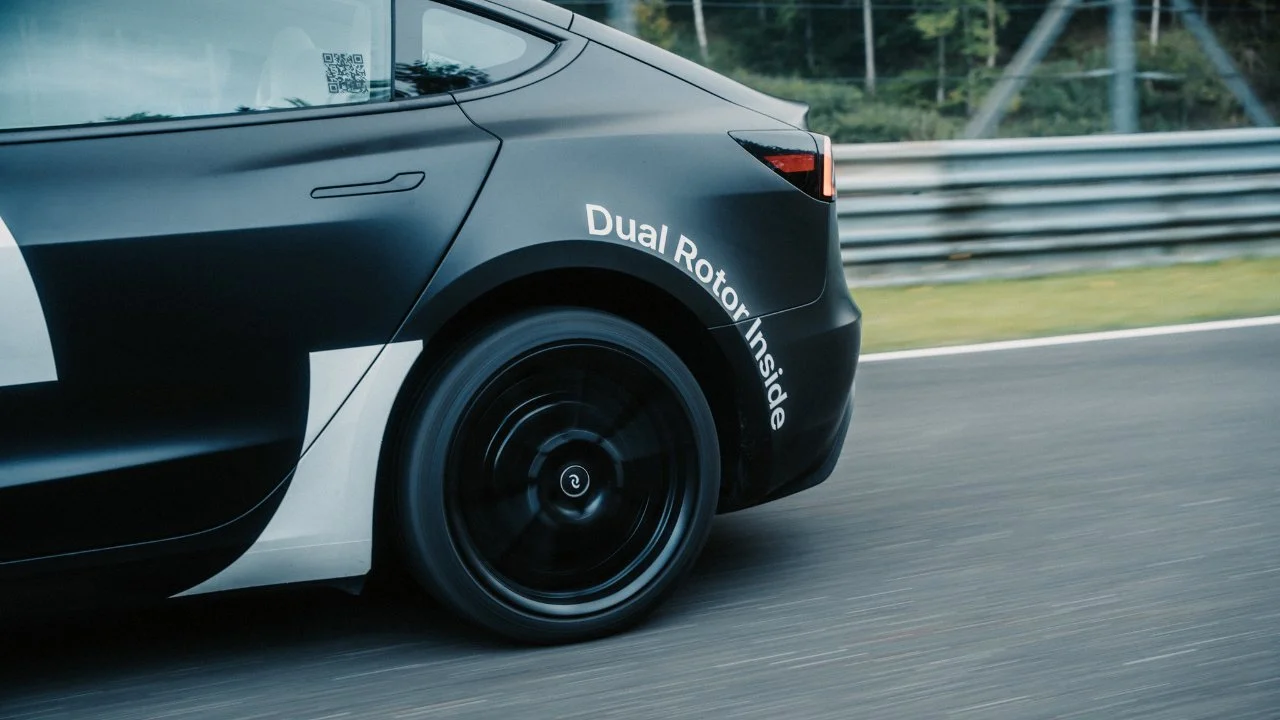
Image Credit: DeepDrive.
And just when I was fully convinced they were all-in on wheels, they pulled a "one more thing." They've used the same dual-rotor technology to build a "central drive" motor. This one is for carmakers who are a bit scared of the in-wheel wizardry and just want a better, normal motor. Because of its clever design, this central motor apparently uses 80% less iron and 50% fewer magnets. With those materials getting eye-wateringly expensive, DeepDrive's solution is not just lighter and more powerful but cheaper.
Normally, at this point, I'd say, "Brilliant. Another fantasy. Call me when you've actually built one." Except they have. And they're not funding this on Kickstarter. They've already raised over $53 million. And who, you ask, wrote those checks? Oh, nobody important. Just BMW i Ventures and Continental. Yes. The people who actually build the cars and the brakes are paying these kids to make their revolution a reality.

Image Credit: DeepDrive.
Their plan is to be ready for "small series" production by 2028. At first, you'll see these as simple all-wheel-drive add-ons for existing EVs. But in the medium term, when platforms are designed around this tech? That's when the fun starts. That's when we get the flat floors, the autonomous pods, and - this is the real dream - the potential for regenerative braking so powerful it could make mechanical brakes completely redundant.
Is it all just a bit too ambitious? Absolutely. But for the first time in a long time, when a start-up promises me a revolution, I'm actually, annoyingly, starting to believe them.
