
Image Credit: Mazda.
I need to confess something. I'm a rotary geek. Yes, I know. It's a sickness. I've owned an RX-7, and I've rebuilt an RX-7. Many times. I've stared at a triangular rotor, covered in my own blood and grease, wondering why I subject myself to this. The Wankel engine is, by any sane measure, a terrible idea. It drinks fuel like a battleship, burns oil by design, and has all the low-end torque of a fluffy gerbil.
And yet... my goodness. There is nothing on this Earth like a twin-rotor at full chat, screaming its metallic heart out at 9,000 RPM. It's a noise that makes you feel alive. Right up until the moment an apex seal gives up, and it suddenly sounds like a blender full of wrenches.

Image Credit: Mazda.
For years, we rotary-faithful have been a sad bunch, huddled in forums whispering about "the good old days." We've been told our inefficient triangles are dead, killed by emissions and common sense. But then, Mazda, the lunatics that they are, went and revealed a concept. And not just any concept. A concept that pairs a twin-rotor engine with a plug-in hybrid system.
At first, I was furious. An electric motor? In my rotary? It's sacrilege! It's ketchup on a prime rib! But then... I thought about it. What if this is it? What if this is the answer? What if you get that high-RPM scream, but with actual, usable power and a range that lets you drive farther than your own driveway? Quiet, you purists in the back. This might just be the way.

Image Credit: Mazda.
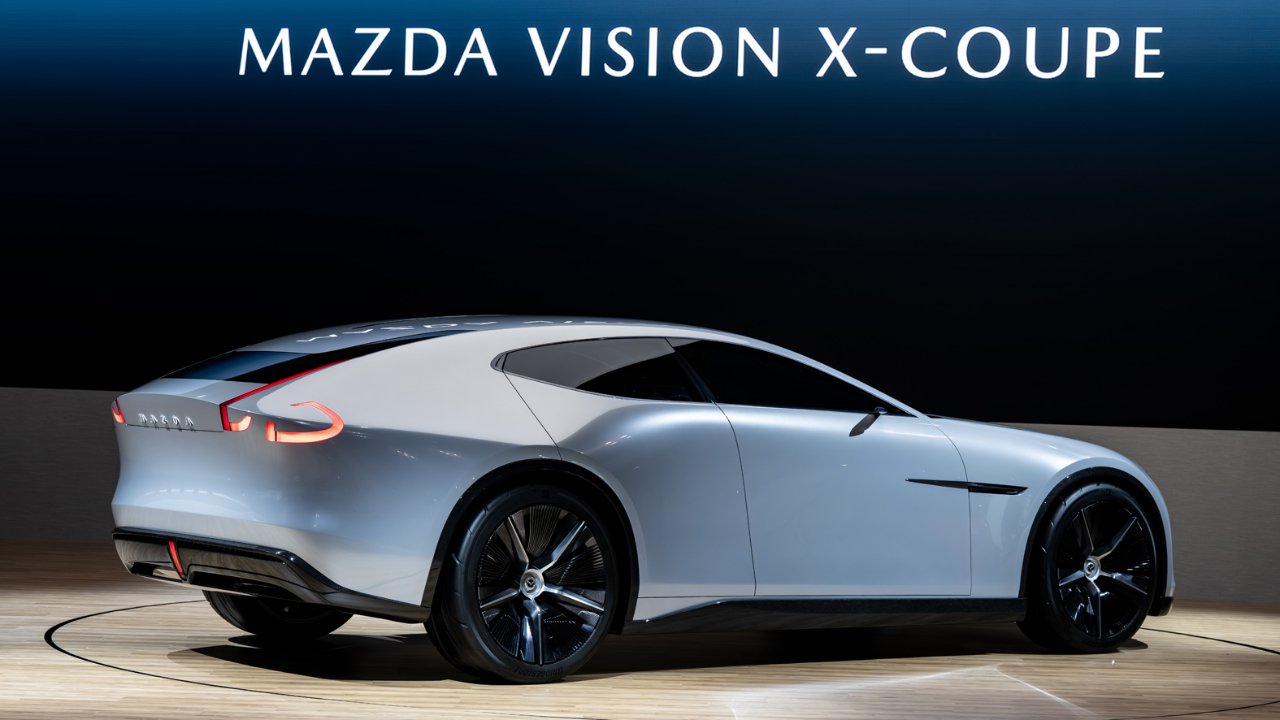
The spaceship is called the "Vision X-Coupe." The name sounds like it was chosen by an 11-year-old, but the best bit is that Mazda calls it a "coupe." I, personally, am not a dictionary. But I am a man with eyes. And my eyes see four doors. Four. This is a sedan. Or a "four-door coupe." Wait, wasn't the RX-8 a four-door coupe? Mazda, you naughty bunch…
Naming conventions aside, just look at it. It is, in classic Mazda concept fashion, achingly beautiful. The hood is so long it might arrive five minutes before the rest of the car. The bodywork is smooth, dramatic, and looks like it was poured from liquid metal. It's a four-seat, four-door machine that's apparently "a smidgen longer and taller" than an Aston Martin Vanquish. That means it's a big boy - over 15.5 feet long - but a bit narrower. It's sleek, it's aggressive, and it has absolutely zero chance of ever being built.

Image Credit: Mazda.
Mazda says this is a taste of what they're thinking for... 2035. That's it. By then, I'll be old, grumpy, and probably communicating exclusively by shouting at a robot assistant. But I digress. According to Mazda, the Vision X-Coupe isn't a car. Yeah, it's a "Human Body Sensing Model," which is supposed to create an "emotional connection." Look, Mazda, you had my emotional connection at "turbocharged rotary." You don't need to add techno-babble.
Let's get to the good stuff. The oily bits. Or, in this case, the oily and... sparky bits. Under that continent-sized hood is a turbocharged, twin-rotor engine - he's back! But he's brought a friend: an electric motor and a battery pack. Together, this unholy alliance of gasoline and lightning delivers claimed 503 horsepower. Five hundred in a stock Mazda? "Zoom-Zoom" my a… This is "Clear-the-Runway."

Image Credit: Mazda.
Mazda, being frustratingly vague as always, didn't release any other specifics. Engine size? Battery capacity? 0-to-60 time? Top speed? Not a clue. All they said is that the battery is big enough to give you "almost 100 miles" of pure-electric range. That's not bad, probably enough to handle the daily commute in silence, saving the rotary's glorious noise for when you actually want it. With the engine and motor working together, they claim a total range of "nearly 500 miles." A 500-mile rotary? We truly are living in the future.
Unfortunately, like in any Netflix drama worth its subscription, there's a twist, a moment where the story goes from interesting to "full-blown science fiction." This rotary engine doesn't run on regular old gasoline, because that would be too simple. Instead, it runs on a "carbon-neutral fuel made from microalgae." Yup, this old Wankel runs on algae. Pond scum. I am driving a car, powered by the stuff that ruins your backyard swimming pool. I'm inclined to check if the engineers who designed this have been sniffing the exhaust.

Image Credit: Mazda.
But as if running on algae wasn't enough, Mazda is also developing something called "Mazda Mobile Carbon Capture." This supposedly harvests carbon dioxide from the exhaust so it can be recycled. This car, according to Mazda, reduces atmospheric CO2 the more you drive it. Right. And I suppose if I drive it backward, it'll make me younger? This is the most wonderful piece of automotive fantasy I've heard in decades. A car that eats its own pollution? What's next, an exhaust that smells like lavender and cures baldness?
We didn't get a good look at the interior, but what we can see is interesting. It's simple, which I like. The driver gets a trio of circular digital gauges, a wonderful change from the gigantic, brick-like tablets infesting every other new car dashboard. But then, right in the center console, there's a physical, old-school shift lever. In a plug-in hybrid concept for 2035? Why? Is it for shifting the rotary? Does the electric motor have gears? Or is it just there to give your hand something to do? It makes no sense, and I absolutely love it.

Image Credit: Mazda.
Will I be able to walk into a Mazda dealer in 2035 and buy a 503-horsepower, algae-powered, carbon-capturing four-door "coupe"? Not a chance. Don't be silly. This is a dream. A beautiful, but completely unhinged dream. It shows that the little company from Hiroshima hasn't lost its soul. They're still the weird ones. They're still the engineers who won't let a bad idea like the rotary engine die. And they're still building things that make people like me smile. Though I could have never imagined that the future of rotary power would faintly smell of fish.
Enjoyed the article? Give us a 'LIKE' and FOLLOW us on MSN! We're tracking the electric future... even if it's still buffering.
